Dry Needling vs. Acupuncture: What's the Difference?
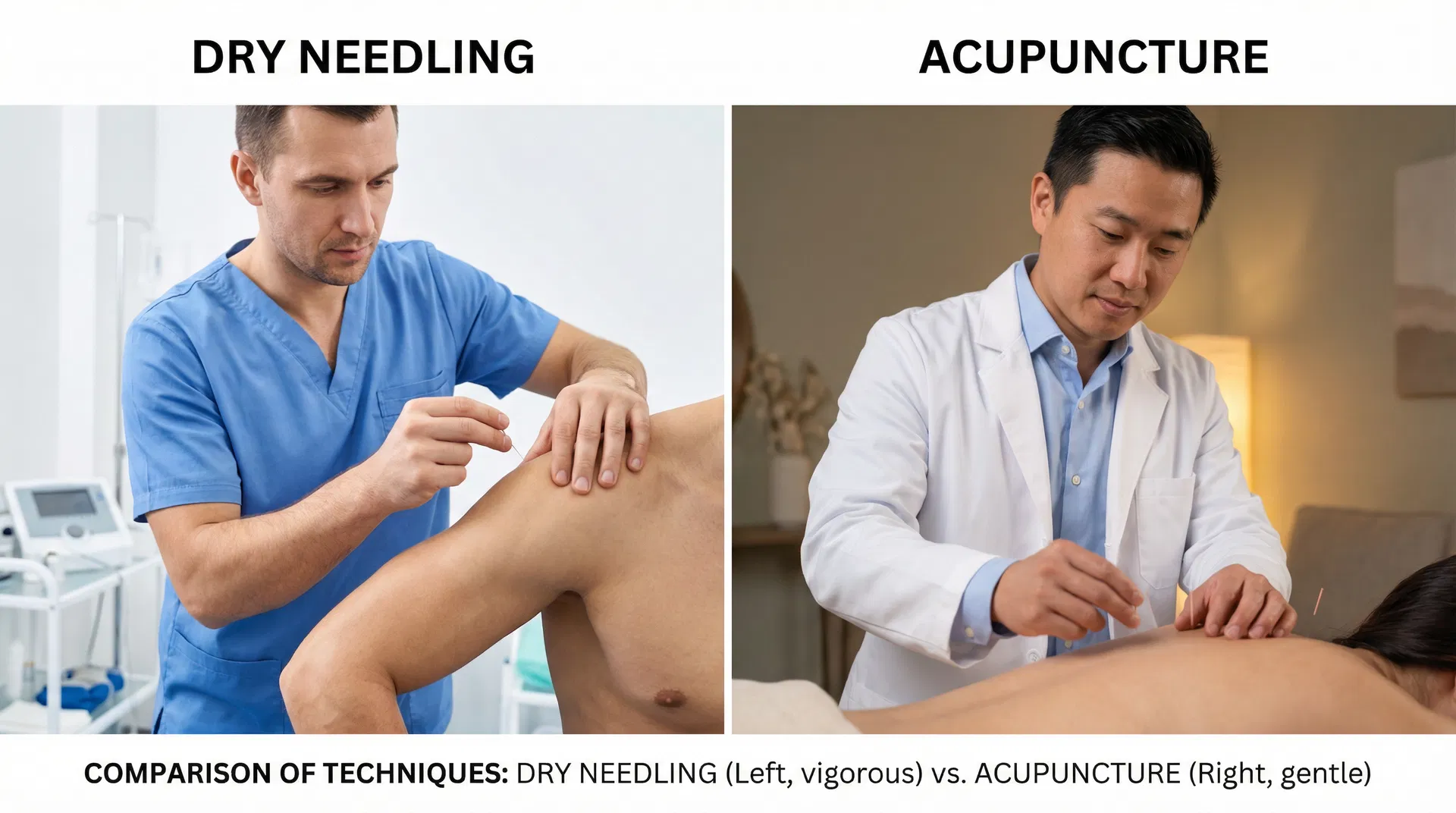
Dry Needling vs. Acupuncture: What's the Difference?
Understanding the Key Differences Between Dry Needling and Acupuncture
If you've been searching for pain relief options, you've likely encountered both dry needling and acupuncture. While these therapies might seem similar on the surface—both use thin needles to treat pain—they are fundamentally different approaches rooted in distinct training, philosophies, and techniques. Understanding these differences is crucial to choosing the right treatment for your specific condition.
The Core Difference: Who Performs Each Therapy
The primary distinction between dry needling, acupuncture, and medical acupuncture comes down to who performs the procedure and their level of training:
- Licensed Acupuncturists perform acupuncture
- Chiropractors and Physical Therapists perform dry needling
- MDs perform medical acupuncture
This difference in practitioners reflects dramatically different training requirements and clinical expertise.
Training Requirements: A Significant Gap
Understanding the training behind each therapy reveals why practitioners approach treatment so differently:
Licensed Acupuncturist (Tennessee & California)
- California Requirements: 2,050 classroom hours + 950 supervised clinic hours (4-year Master's program)
- Tennessee Requirements: 700 classroom hours + 660 supervised clinic hours
- Total Training: Over 2,000+ hours of comprehensive education and clinical practice
Dry Needling for Physical Therapists (Tennessee)
- Training Required: 50 hours
Dry Needling for Chiropractors (Tennessee)
- Training Required: 250 hours
Medical Acupuncture for MDs (Tennessee)
- Training Required: None (no additional training is required)
This dramatic difference in training hours directly impacts the depth of knowledge, diagnostic ability, and treatment versatility each practitioner brings to patient care.
How Acupuncture and Dry Needling Differ: Techniques & Philosophy
Acupuncture: A Comprehensive Approach
Licensed acupuncturists are trained in both Traditional Chinese Medicine (TCM) diagnosis and Western Medicine diagnosis. This dual training creates a unique advantage:
TCM Principles:
- Combines philosophical concepts of yin and yang, the five elements, and organ theory
- Focuses on balancing the body's vital energy (Qi)
- Addresses root causes, not just symptoms
Treatment Techniques:
- Local needling: Needles placed directly in the area of pain
- Distal needling: Needles placed away from the pain site to address underlying imbalances
- Additional modalities: Cupping, moxibustion, acupressure, herbal medicine
Why This Matters:
Acupuncturists have a wider range of techniques and can vary treatments based on how a patient responds. Because the training is so much more extensive, the ability to diagnose and formulate a comprehensive treatment plan is significantly greater.
Think of it this way: If your body is a house with multiple rooms (kitchen, bathroom, living room) and multiple systems (plumbing, electrical, structural), a licensed acupuncturist is like a general contractor who can work on any aspect of the house—roof repairs, electrical systems, bathroom remodels, and more. Dry needling, by contrast, is like hiring a plumber who only works on plumbing. They're very proficient at that particular trade, but you wouldn't ask a plumber to repair your electrical system.
Dry Needling: Targeted Muscle Treatment
Dry needling techniques are limited to treating pain and typically involve trigger point therapy:
Key Characteristics:
- Needles are placed in areas of pain or tenderness
- Strong, vigorous stimulation is used
- Focuses on releasing tight muscle bands (trigger points)
- Uses the same sterile, stainless steel needles as acupuncture
Treatment Scope:
Dry needling is specifically designed for musculoskeletal pain and muscle dysfunction. It does not address broader health conditions or systemic imbalances.
Medical Acupuncture: Variable Approaches
While no additional training is required for MDs to perform medical acupuncture, most voluntarily attend seminars to learn acupuncture skills. The challenge: styles of medical acupuncture are extremely varied and cannot be quickly summarized. Some medical acupuncturists receive excellent classroom training, but clinical hours are usually lacking.
Why Is Pain Worse After Dry Needling?
One of the most common questions patients ask is: "Why is my pain worse after dry needling?"
The answer lies in the technique itself:
Dry needling muscle techniques are usually very vigorous, often involving:
- Larger needle gauges
- Strong, forceful stimulation
- Electrical stimulation
- Aggressive muscle release techniques
This doesn't mean every patient will experience increased pain after dry needling. However, the chances of pain being worse after dry needling are higher than with acupuncture because:
1. Acupuncture focuses on placement and channel theory rather than aggressive muscle stimulation
2. Acupuncture addresses internal medical causes of pain, not just local muscle tension
3. Acupuncture uses only the force necessary to achieve the desired therapeutic effect
4. Acupuncture's gentler approach often results in less post-treatment soreness
If you experience increased pain after dry needling, this is often a normal response to the vigorous technique. However, it's important to discuss this with your practitioner to ensure the treatment is appropriate for your condition and tolerance level.
What the Patient Experiences: Treatment Differences
With a Licensed Acupuncturist
The types of questions an acupuncturist asks combine what you typically experience with questions specific to Traditional Chinese Medicine:
- Does your condition improve with heat or cold?
- Is it worse during the day or night?
- Do you experience excessive thirst?
- How is your digestion and energy level?
The Treatment Experience:
- Acupuncture performed by a licensed acupuncturist is usually not as vigorous as dry needling
- This doesn't mean it's less effective—acupuncturists use only the force necessary to achieve the desired effect
- Treatments are often more comfortable and relaxing
- Patients typically experience less post-treatment soreness
With a Dry Needling Practitioner
The Treatment Experience:
- Dry needling is usually very vigorous and stimulating
- The best candidates for dry needling tend to be athletic and robust individuals
- Expect stronger sensations during treatment
- Post-treatment soreness is more common
With a Medical Acupuncturist
Medical acupuncture techniques vary greatly depending on the training the practitioner has received—or hasn't received. Without standardized requirements, the quality and approach can be unpredictable.
Similarities Between Dry Needling and Acupuncture
Despite their differences, these therapies do share important commonalities:
1. Same equipment: Both use sterile, stainless steel acupuncture needles (single-use)
2. Pain relief: Both therapies are effective for treating pain
3. Non-invasive: Both are minimally invasive procedures
4. Safety profile: When performed by trained practitioners, both are safe
Choosing the Right Therapy for You
Choose Acupuncture if you:
- Want a comprehensive approach to your health condition
- Have multiple health concerns beyond just pain
- Prefer a gentler treatment approach
- Want to address root causes, not just symptoms
- Are interested in preventive care and wellness
Choose Dry Needling if you:
- Are athletic or robust and tolerate vigorous treatment
- Have been recommended it by your physical therapist or chiropractor
The Bottom Line
While dry needling and acupuncture both use needles, they represent fundamentally different approaches to healing. Acupuncture, performed by extensively trained licensed acupuncturists, offers a comprehensive, holistic approach grounded in thousands of years of medical practice and modern clinical training. Dry needling, while effective for specific muscular conditions, is a more limited technique focused on trigger point release.
The choice between these therapies should be based on your specific condition, your practitioner's training and expertise, and your personal health goals. If you're considering either therapy, ask your practitioner about their training, experience, and approach to ensure you're receiving the most appropriate care for your needs.
Related Conditions & Techniques
Understanding Your Acupuncture Options:
- Why Is Pain Worse After Dry Needling? What to Expect — Recovery timeline and post-treatment soreness management
- Medical Acupuncturist vs. Licensed Acupuncturist: Understanding the Critical Differences — Training requirements and scope of practice comparison
Acupuncture for Pain Management:
- Acupuncture for Sciatica: Relief from Nerve Pain — Comprehensive nerve pain treatment
- Acupuncture for Hip Misalignment: Fixing Out of Place Hips — Address alignment issues and muscle tension
- Acupuncture for Piriformis Syndrome: Deep Buttock Pain — Often mistaken for sciatica
- Acupuncture for Chronic Pain: Long-Term Relief Without Medication — Holistic approach to pain management
FAQ: Dry Needling vs. Acupuncture
Q: Are dry needles and acupuncture needles the same?
A: Yes, they use the same sterile, stainless steel needles. The difference is in how they're used and the training of the practitioner.
Q: Can a physical therapist perform acupuncture?
A: No. Physical therapists can perform dry needling with appropriate training, but acupuncture can only be performed by licensed acupuncturists. The training requirements are dramatically different.
Q: Is acupuncture more effective than dry needling?
A: Both are effective for their intended purposes. Acupuncture is more comprehensive and addresses broader health conditions, while dry needling is specifically effective for muscular pain and trigger points.
Q: Why do some people experience more pain after dry needling?
A: Dry needling uses vigorous, strong stimulation to release tight muscles. This can result in post-treatment soreness, especially in patients who are not accustomed to aggressive muscle work.
Q: How many hours of training does a licensed acupuncturist have?
A: In California, licensed acupuncturists complete 2,050 classroom hours plus 950 supervised clinic hours (4-year Master's program). In Tennessee, requirements are 700 classroom hours plus 660 supervised clinic hours.
Q: Can medical doctors perform acupuncture?
A: Yes, but no additional training is required in Tennessee. While many MDs voluntarily attend seminars, there is no standardized requirement, so the quality and depth of training varies significantly.