How Stress & Anxiety Affect Fertility: Understanding the Pregnenolone Steal
How Stress & Anxiety Affect Fertility: Understanding the Pregnenolone Steal
Stress and anxiety are silent fertility killers. If you have noticed your period becoming irregular during stressful times, or your PMS symptoms worsening, you are experiencing the physiological impact of stress on your reproductive system. Severe stress and anxiety can even suppress ovulation entirely, making conception impossible. Understanding the mechanism behind this—the pregnenolone steal—is the first step toward reclaiming your fertility.
The Pregnenolone Steal: How Stress Robs Your Fertility
Understanding Pregnenolone
Pregnenolone is the fundamental building block from which all steroid hormones are derived. Think of it as the raw material your body uses to create:
- Progesterone — Essential for maintaining pregnancy and regulating menstrual cycles
- Estrogen — Critical for egg development and ovulation
- Testosterone — Important for sexual desire and reproductive health
- DHEA — A precursor to sex hormones and a marker of youthful vitality
- Cortisol — Your body's primary stress hormone
The problem is that pregnenolone has a limited supply, and your body must decide how to allocate it. Under stress, your body prioritizes survival over reproduction—and that's where the pregnenolone steal begins.
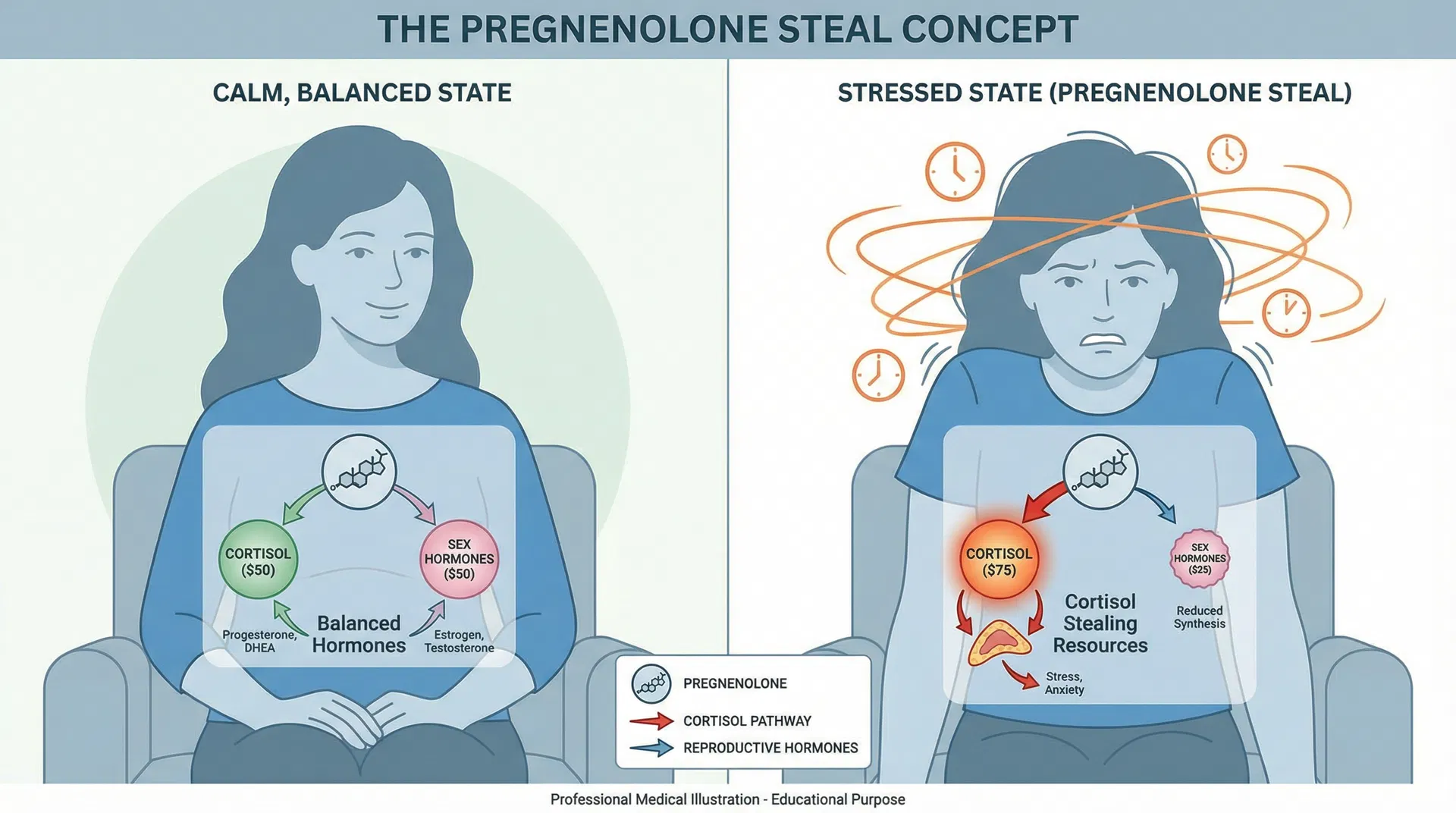
The $100 Pregnenolone Piggy Bank
Here's a simple way to understand how stress affects your fertility:
Imagine you have $100 in your "pregnenolone piggy bank." Under normal, balanced conditions, your body allocates these resources as follows:
- $50 to cortisol — Your stress hormone, needed to manage daily life stressors
- $50 to DHEA — Which converts to sex hormones (testosterone and estrogen)
This balance allows your body to handle stress while maintaining healthy reproductive function. Your periods are regular, ovulation occurs predictably, and conception is possible.
What Happens When Stress Increases
Now imagine you experience increased stress from finances, work pressures, relationship conflicts, or health concerns. Your cortisol demand increases to $75. Suddenly, you only have $25 left for DHEA and sex hormone production.
This is the pregnenolone steal in action.
The result:
- Irregular or absent periods
- Anovulation (failure to ovulate)
- Poor egg quality
- Increased PMS symptoms
- Reduced fertility
The Problem Gets Worse
In real life, the pregnenolone steal is even more severe because of a secondary mechanism: cholesterol absorption.
Pregnenolone is derived from cholesterol. Under stress and anxiety, your body decreases the secretion of digestive enzymes, which impairs your ability to absorb dietary cholesterol. This means your pregnenolone piggy bank does not even start with $100—it starts with less.
The cascade:
1. Stress increases → Cortisol demand rises
2. Digestive enzyme secretion decreases → Cholesterol absorption decreases
3. Pregnenolone production decreases → Sex hormone production plummets
4. Fertility declines dramatically
How Stress & Anxiety Disrupt Your Cycle
Irregular Periods
When cortisol demand is high, your body shifts resources away from reproductive hormones. The delicate balance of FSH (follicle-stimulating hormone) and LH (luteinizing hormone)—which regulate your menstrual cycle—becomes disrupted. The result is irregular, unpredictable periods or even amenorrhea (complete absence of menstruation).
Suppressed Ovulation
In extreme stress situations, your body may suppress ovulation entirely. From an evolutionary perspective, this makes sense: your body recognizes that the environment is too stressful to support pregnancy, so it prevents conception. While this was adaptive for our ancestors facing physical threats, modern stress (financial, emotional, work-related) triggers the same response—without the corresponding benefit.
Poor Egg Quality
Even if ovulation occurs, chronic stress impairs egg quality. The eggs that do develop are more likely to have chromosomal abnormalities, reducing the chance of successful conception and increasing the risk of miscarriage.
Worsened PMS
As sex hormone production declines, the hormonal fluctuations that trigger PMS become more pronounced. Women under chronic stress often report worse PMS symptoms—mood swings, bloating, breast tenderness, and menstrual pain—as their bodies struggle to maintain hormonal balance.
The Nervous System Connection
Your nervous system plays a crucial role in this process. You have two branches:
The Sympathetic Nervous System — Your "fight or flight" response
- Activated by stress and anxiety
- Increases cortisol production
- Diverts blood away from reproductive organs
- Suppresses digestion and nutrient absorption
The Parasympathetic Nervous System — Your "rest and digest" response
- Activated during relaxation
- Promotes digestion and nutrient absorption
- Supports reproductive function
- Reduces cortisol production
When you are chronically stressed, your sympathetic nervous system is constantly activated. Your body remains in "fight or flight" mode, prioritizing survival over reproduction. This is why relaxation and stress management are so critical for fertility.
How Acupuncture Reverses the Pregnenolone Steal
Acupuncture is one of the most powerful tools for restoring fertility in women experiencing stress-related infertility. It works through multiple mechanisms:
1. Stimulates the Parasympathetic Nervous System
Acupuncture directly activates your parasympathetic nervous system—the "rest and relax" branch of your autonomic nervous system. This is sometimes jokingly called the "feed and breed" nervous system because it is responsible for both digestion and reproduction.
When acupuncture stimulates parasympathetic activation:
- Cortisol production decreases
- Stress response normalizes
- Blood flow returns to reproductive organs
- Digestive function improves
2. Increases Pregnenolone Production
By improving digestive function and nutrient absorption, acupuncture increases the secretion of bile into your digestive tract. This allows your body to absorb more dietary cholesterol, which is the precursor to pregnenolone. Suddenly, your pregnenolone piggy bank has more resources to work with.
3. Restores Hormonal Balance
As cortisol demand decreases and pregnenolone production increases, your body can finally allocate adequate resources to sex hormone production. Your $100 pregnenolone piggy bank returns to its normal allocation:
- $50 to cortisol (stress management)
- $50 to DHEA and sex hormones (reproduction)
This restoration of balance allows:
- Regular menstrual cycles to resume
- Ovulation to be restored
- Egg quality to improve
- Conception to become possible
4. Reduces Anxiety Directly
Beyond the nervous system effects, acupuncture has direct anxiolytic (anxiety-reducing) effects. Patients often report feeling calmer, more relaxed, and more emotionally balanced after acupuncture treatments. This psychological benefit further reduces cortisol production and supports fertility.
Stress Management for Fertility
While acupuncture is powerful, it works best when combined with stress management practices:
Meditation & Mindfulness
Even 10-15 minutes of daily meditation can significantly reduce cortisol levels and activate your parasympathetic nervous system. Meditation teaches your body to recognize and release stress.
Yoga & Gentle Movement
Yoga, particularly restorative or yin yoga, is excellent for fertility. These practices combine physical movement with parasympathetic activation, creating the ideal environment for hormonal balance.
Sleep Optimization
Sleep is when your body repairs itself and rebalances hormones. Aim for 7-9 hours of quality sleep nightly. Poor sleep perpetuates the stress response and impairs fertility.
Dietary Support
Reduce caffeine and sugar, which increase cortisol. Focus on nutrient-dense foods, especially those rich in cholesterol (yes, dietary cholesterol is essential for hormone production):
- Grass-fed beef and lamb
- Wild-caught fatty fish
- Pasture-raised eggs
- Avocado and coconut oil
- Full-fat dairy (if tolerated)
Social Connection
Strong relationships and social support reduce cortisol and improve fertility outcomes. Spend time with loved ones, join support groups, and do not isolate yourself during stressful times.
The Timeline for Recovery
When you begin acupuncture and stress management, fertility typically improves on this timeline:
Weeks 1-4: Sleep improves, anxiety decreases, energy increases
Weeks 4-8: Menstrual cycle begins to regulate, PMS symptoms improve
Weeks 8-12: Cortisol levels normalize, ovulation begins to restore
Months 3-6: Hormonal balance fully restored, egg quality improves, conception becomes possible
Most women require 3-6 months of consistent treatment to fully reverse the pregnenolone steal and restore fertility. Consistency is key—missing treatments or returning to high-stress patterns delays progress.
Your Path Forward
If stress and anxiety are affecting your fertility, you do not have to accept it as permanent. The pregnenolone steal is a physiological response to stress—and it is reversible.
Schedule your acupuncture consultation today. We specialize in fertility support and stress management. Our goal is to help you:
- Reduce stress and anxiety
- Restore hormonal balance
- Improve egg quality
- Achieve regular ovulation
- Conceive naturally
In Balance Acupuncture Clinic
Franklin, Tennessee
(615) 260-6944
www.ibaclinic.com
---
Related Articles
Learn more about fertility and stress management:
- Acupuncture for PCOS: Supporting Fertility & Hormonal Balance — Manage PCOS and restore ovulation
- Fertility Acupuncture: Comprehensive Treatment for Conception — Complete fertility support for all causes
- Acupuncture for Anxiety: Natural Stress Relief — Reduce anxiety and support mental health
- Acupuncture for Insomnia: Restful Sleep Without Medication — Improve sleep quality to support fertility
---
FAQ: Stress, Anxiety & Fertility
Q: Can stress really prevent pregnancy?
A: Yes. Chronic stress suppresses ovulation and impairs egg quality through the pregnenolone steal mechanism. Severe stress can even cause amenorrhea (complete absence of menstruation).
Q: How long does it take for acupuncture to help?
A: Most women notice improved sleep and reduced anxiety within 1-2 weeks. Menstrual cycle improvements typically appear within 4-8 weeks. Full hormonal restoration can take 3-6 months of consistent treatment but results are not guaranteed and vary by patient.
Q: Can I do acupuncture while trying to conceive?
A: Absolutely! Acupuncture is safe and beneficial during conception attempts. In fact, we recommend continuing treatment through conception and into early pregnancy for optimal support.
Q: What if I cannot eliminate stress from my life?
A: You do not need to eliminate stress entirely—that is unrealistic. Instead, focus on managing your stress response through acupuncture, meditation, yoga, and other relaxation practices. This allows your body to maintain hormonal balance despite external stressors.
Q: Should I combine acupuncture with other fertility treatments?
A: Yes. Acupuncture works synergistically with conventional fertility treatments, IVF, IUI, and other approaches. Many fertility clinics now recommend acupuncture as a complementary therapy.
Q: How often should I get acupuncture for fertility?
A: We typically recommend 1 session per week for 3-6 months to see meaningful results. Consistency is more important than frequency—regular weekly sessions are essential for optimal outcomes.